Tag: travel

  • Five Most Iconic Murals in Belfast

    The Bobby Sands Mural – Falls Road
    Image

    Where is it?
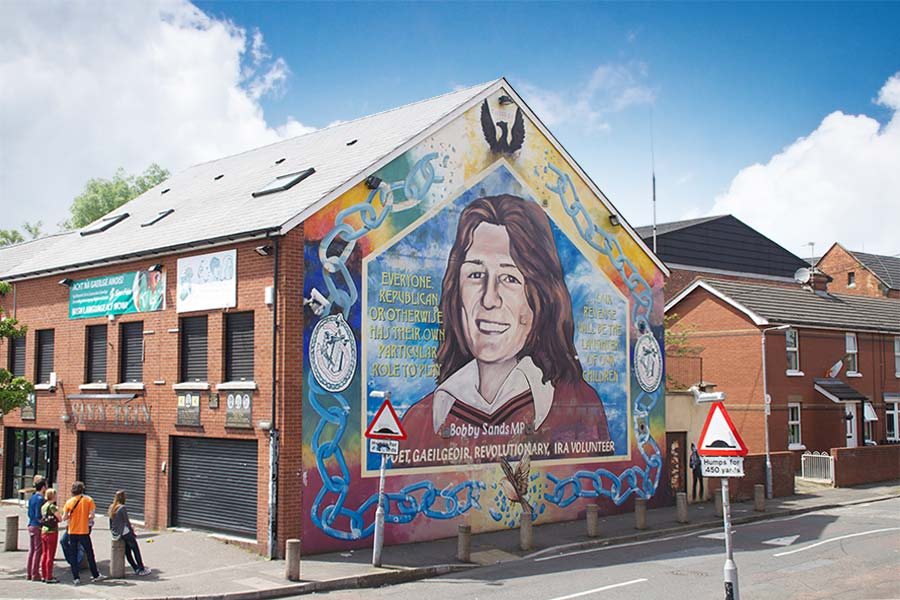
    On the gable wall of Sinn Féin’s offices on the Falls Road, at the corner of Sevastopol Street in West Belfast.

    What does it show?
    A large smiling portrait of Bobby Sands, with a quote:

    “Everyone, Republican or otherwise, has their own particular role to play.”

    The mural also includes Celtic knotwork, doves and a black phoenix at the top – a symbol of rebirth adopted by the republican movement after the late-1960s violence in the area.

    What story does it tell?
    Bobby Sands was a Provisional IRA member and prisoner who died on hunger strike in 1981, after being elected as an MP while in jail. His death, and the wider hunger strikes, became a turning point in the conflict, pushing republicanism further towards electoral politics.

    The mural is probably the single most recognisable mural in Northern Ireland, appearing in guidebooks, documentaries and on almost every Black Taxi tour.

    Why visit?
    Standing in front of it, you’re right in the heart of nationalist West Belfast. You can feel how art, memory and politics are still tightly woven together here.

    The International Wall – Divis Street / Falls Road
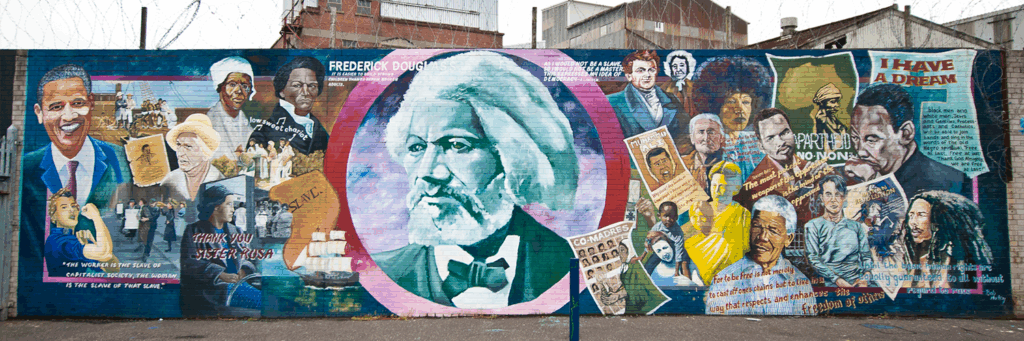
    Image

    Where is it?
    Along Divis Street, just before it becomes the Falls Road, at the edge of West Belfast near Divis Tower and the Peace Wall.

    What does it show?
    Not one mural but a long stretch of constantly changing pieces – portraits, scenes and slogans about:

    • Irish history and the 1916 Easter Rising
    • Global struggles and human-rights campaigns (Palestine, anti-racism, anti-apartheid, political prisoners, etc.)
    • More recently, a strong focus on solidarity with Gaza and Palestinian artists, which led some to dub it the “Palestinian Wall”.

    What story does it tell?
    The International Wall takes the local experience of conflict and connects it to struggles elsewhere. Instead of a single narrative, you get a rolling exhibition of political street art – about oppression, resistance, and demands for justice around the world.

    Why visit?
    If you only have time for one spot, make it here. You can walk the length of the wall, read the captions, and see how new layers of history get painted literally over old ones.

    King Billy Mural – Sandy Row
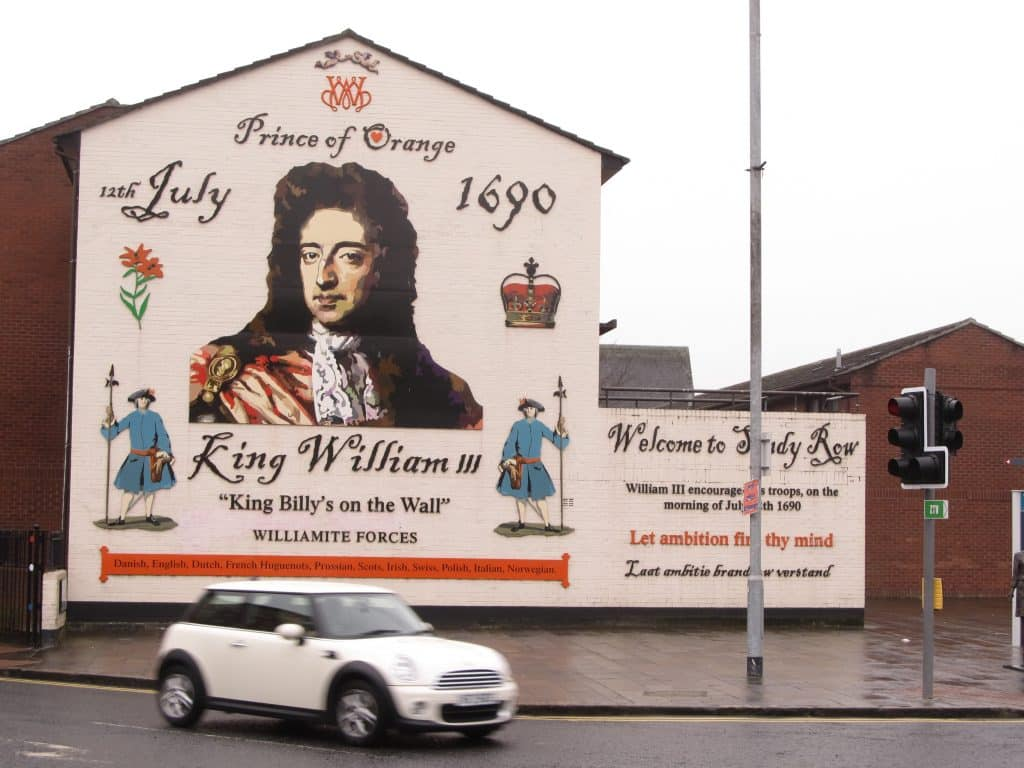
    Image

    Where is it?
    On Sandy Row in South Belfast, a few minutes’ walk from the city centre, on the gable wall at the heart of this traditionally loyalist community.

    What does it show?
    A huge portrait of King William III (William of Orange) with the text:

    • “Prince of Orange”
    • The date 12th July 1690
    • “King William III – King Billy’s on the Wall”
    • References to the Williamite forces and a welcoming text to Sandy Row on the side wall

    You’ll also spot crowns, heraldic symbols and sometimes banners overhead declaring the area “British and Proud.”

    What story does it tell?
    The mural celebrates King William’s victory over King James II at the Battle of the Boyne (1690), a foundational story for many unionists and loyalists:

    • Defence of Protestant civil and religious liberties
    • Loyalty to the British Crown
    • A long, proud local history in Sandy Row

    The mural has been redesigned over the years to look more polished and less militaristic, reflecting a wider move in some loyalist areas towards heritage and tourism rather than overt paramilitary imagery.

    Why visit?
    Because it’s one of the clearest visual statements of loyalist identity in Belfast – and it’s very central. If your blog is aimed at visitors, this is an easy stop to combine with city-centre sightseeing, giving a flavour of the Orange tradition without going deep into West Belfast.

    “Welcome to the Shankill Road” – Gardiner Street
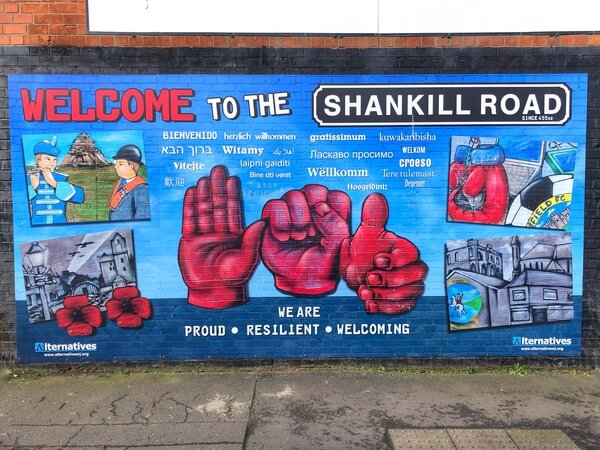
    Image

    Where is it?
    On Gardiner Street, just off the Shankill Road. It’s the newer “Welcome to the Shankill” mural that replaced an older version around 2019.

    What does it show?

    • A bright blue background with three red hands spelling “WELCOME” in sign language
    • Panels showing parts of local life: parades, bonfires, sports, wartime history and other murals
    • A line along the bottom: “We are PROUD • RESILIENT • WELCOMING”

    It also lists “welcome” in many languages – Polish, for example, appears – though notably Irish isn’t included, something that sparked local debate.

    What story does it tell?
    This mural is less about the Troubles and more about modern community identity:

    • Pride in the area’s long history
    • An attempt to present the Shankill as open and friendly
    • A hint of ongoing tension in what isn’t shown (like the absence of Irish)

    It’s a reminder that murals here don’t just look backwards – they also argue about what the present and future of the neighbourhood should look like.

    Why visit?
    It’s one of the best spots to photograph a more upbeat side of Shankill Road and to see how imagery, language and inclusion/exclusion are still negotiated on the wall.

    CS Lewis “Narnia” Mural – East Belfast
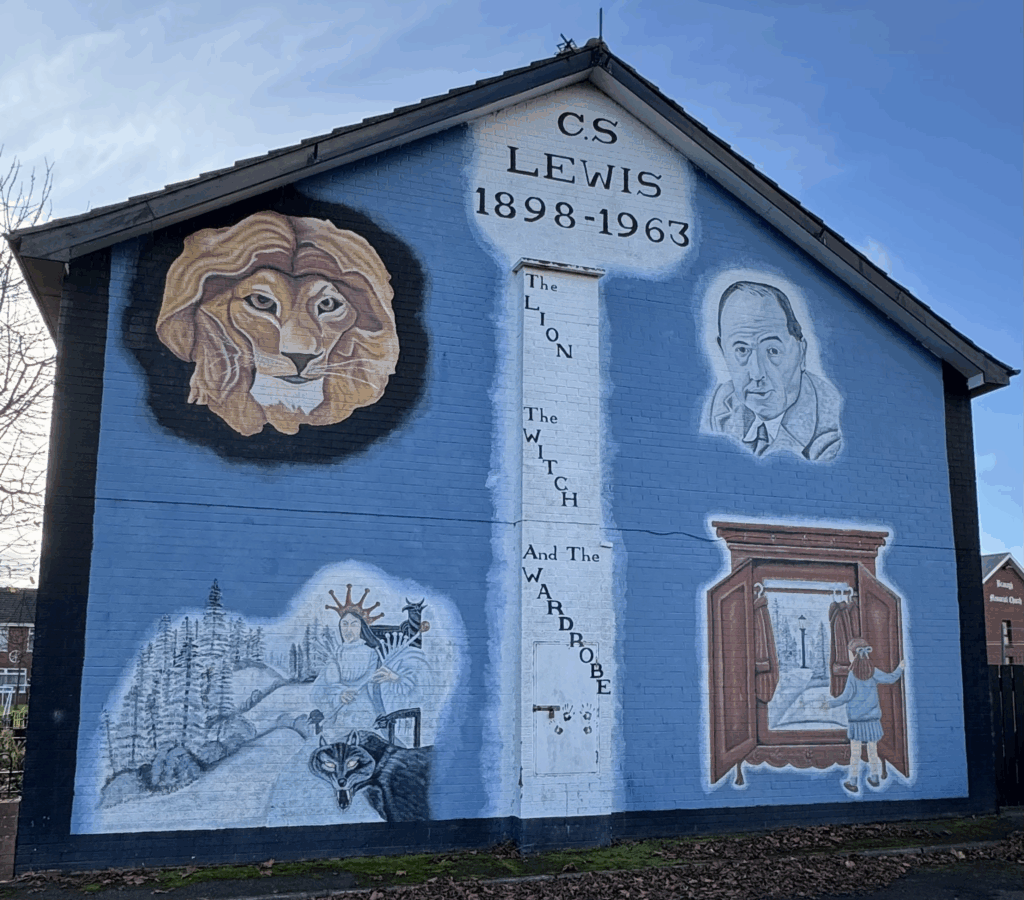
    Image

    Where is it?
    On a gable wall in Convention Court, just off the Newtownards Road in East Belfast, close to the Holywood Arches area.

    What does it show?

    • A big blue wall with “C.S. LEWIS 1898–1963” at the top
    • A painted book spine of The Lion, the Witch and the Wardrobe
    • A portrait of CS Lewis himself
    • Narnia imagery: Aslan, the White Witch’s snowy landscape, and the wardrobe doorway

    What story does it tell?
    This one steps away from the Troubles and celebrates Belfast’s cultural heritage:

    • CS Lewis was born in Belfast (in nearby Dundela Avenue), and East Belfast likes to claim him as one of its own.
    • The mural ties into a wider “Narnia trail” in the area (including CS Lewis Square and other pieces of street art), showing how the city is now branding itself through literature, fantasy and creativity instead of conflict.

    Why Visit?
    For visitors, this mural is a perfect stop if you want something a bit gentler than the political walls of West Belfast. It’s bright, imaginative and great for photos, and it links directly to CS Lewis Square and the wider Narnia trail nearby – so you can turn it into a mini literary walk in East Belfast, with cafés and local shops close at hand.
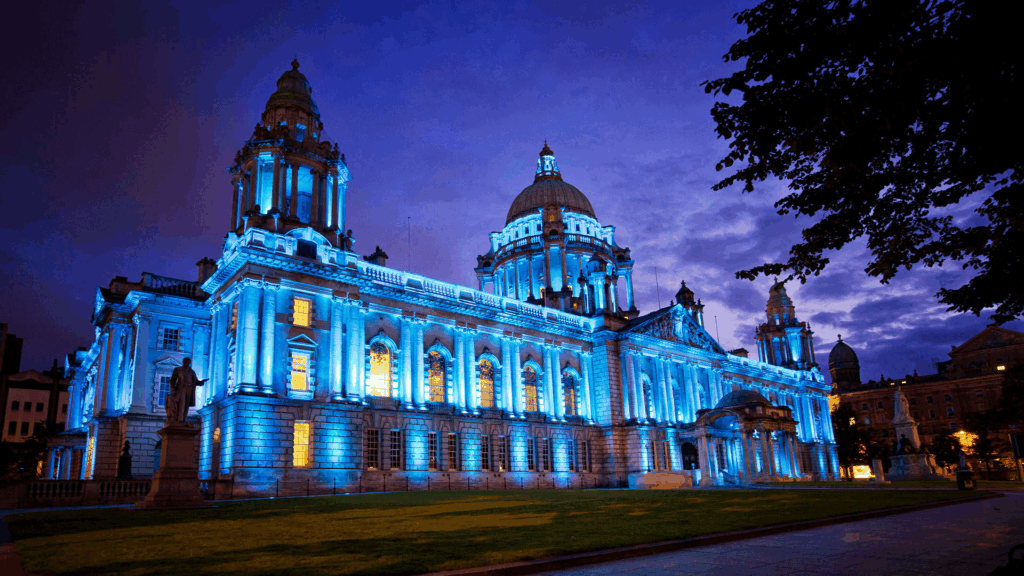
  • Belfast City Hall

    Belfast City Hall

    On Donegall Square, Belfast City Hall sprawls like an Edwardian “wedding cake” of Portland stone and copper—grand, symmetrical, and impossible to miss. Designed by Sir Alfred Brumwell Thomas, construction began in 1898 and finished in 1906, crowning the city’s new status as a bustling industrial capital.

    City Hall replaced the old White Linen Hall and signalled civic confidence during Belfast’s boom years. It has witnessed everything from royal visits to wartime blackouts and post-conflict celebrations. A major restoration closed the building in 2007–2009, renewing services and interiors (about £10.5 m across phases), before reopening to the public with refreshed tours and galleries.

    Out on the lawns, memorials trace the city’s story: the Cenotaph to WWI dead and the Titanic Memorial Garden—opened on 15 April 2012—whose bronze plaques uniquely list all 1,512 victims of the disaster.

    Quick Facts:

    • Architect & style: Sir Alfred Brumwell Thomas, Baroque Revival/Edwardian grandeur.
    • Built: 1898–1906; cost: ~£360–369k (then).
    • Dome: ~173–174 ft (53 m), copper-clad; corner towers on all four sides.
    • Materials: Portland stone exterior; rich marbles inside.
    • Today: HQ of Belfast City Council; free public exhibition, tours, and café (“The Bobbin”).
  • Europa Hotel

    Image

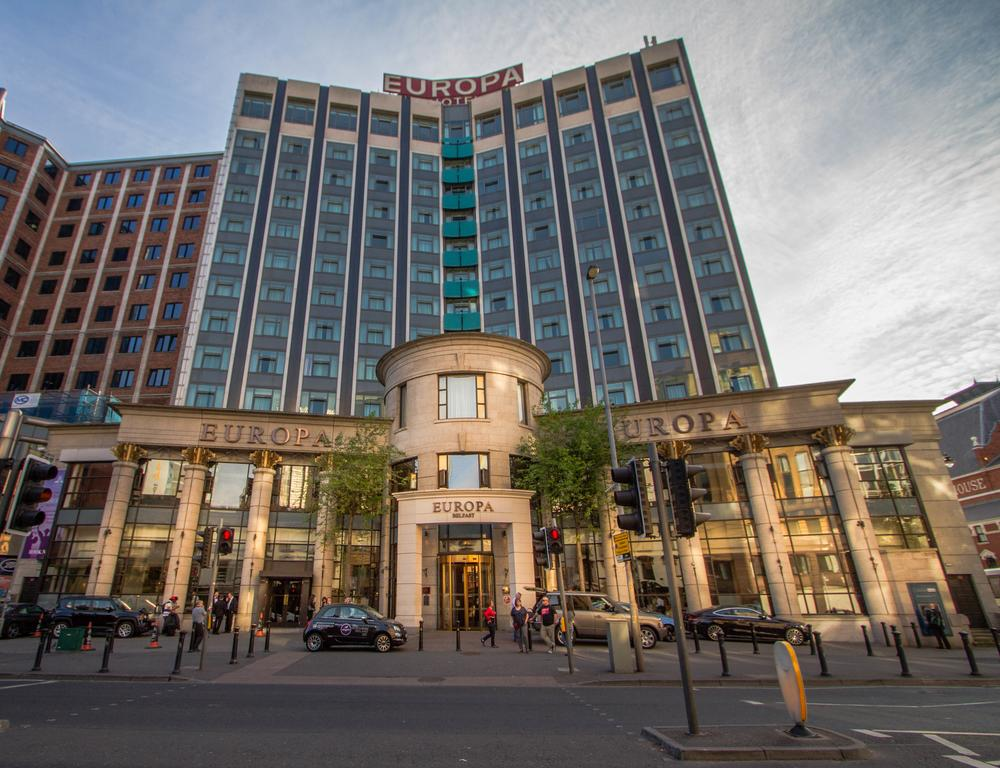
    On Great Victoria Street, the Europa Hotel rises like a silvered time capsule of Belfast’s grit and charm. Opened in 1971 on the site of the old Great Northern Railway terminus, the 12-storey, 51 m tower by Sydney Kaye, Eric Firkin & Partners became a front-row seat to history—and a city-centre beacon again today.

    Quick Facts:

    • Opened: July 1971; Architects: Sydney Kaye, Eric Firkin & Partners.
    • Height / floors: ~51 m, 12 storeys.
    • Rooms: 272 (after later extensions/refurbs).
    • Famous claim: Often described as the “most bombed hotel”—accounts vary, with sources citing ~28–33 attacks during the Troubles.

    From Troubles to turnaround

    Journalists made it their base through the worst years, but the hotel kept trading, then found a second life when Hastings Hotels bought it in 1993, invested ~£8 m and reopened in 1994. In November 1995, President Bill Clinton stayed here (110 rooms were booked for the entourage); the penthouse suite he used became the Clinton Suite. Recent years brought a five-year, £15 m refurbishment across all 272 rooms, bars, and meeting spaces—sealing the Europa’s status as a polished city landmark.

  • Titanic Museum

    Image

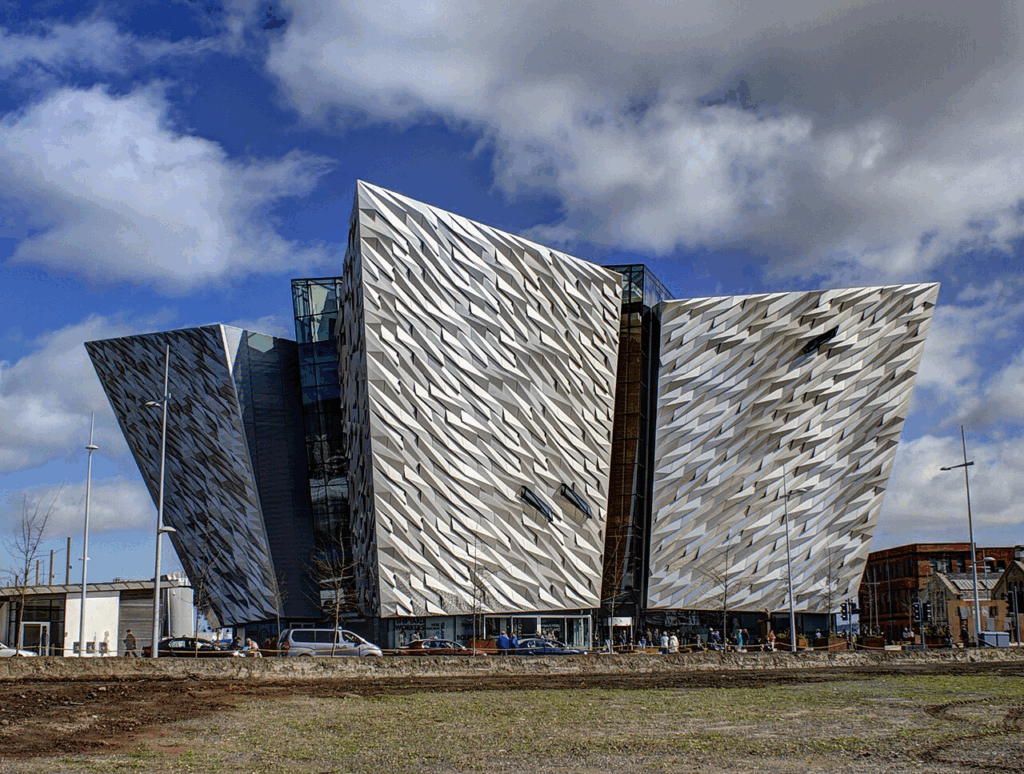
    On the old Harland and Wolff slipways, Titanic Belfast lifts four glittering “prows” into the sky—part ship, part iceberg, all theatre. Conceived by CivicArts / Eric R. Kuhne and Associates and delivered with Todd Architects, the 8-storey landmark opened for the centenary in March 2012 and has since become Belfast’s postcard icon.

    Quick facts:

    • Where and when: Titanic Quarter, on the very ground where RMS Titanic and Olympic were built; ground broke in 2009, doors opened 31 March 2012.
    • Architects: Concept by CivicArts / Eric R. Kuhne & Associates; lead consultants Todd Architects.
    • Height and scale: 38.5 m (126 ft) at the peak, roughly the height of Titanic’s hull; around 12,000–14,000 m² of floorspace.
    • Cladding: ~3,000 anodised aluminium “shards,” about 2,000 unique; ~6,200 m² of rainscreen.
    • Cost: ~£101 million.
    • Awards: World’s Leading Tourist Attraction (2016) at the World Travel Awards; also Europe’s Leading Visitor Attraction that year.

  • Obel Tower

    Image

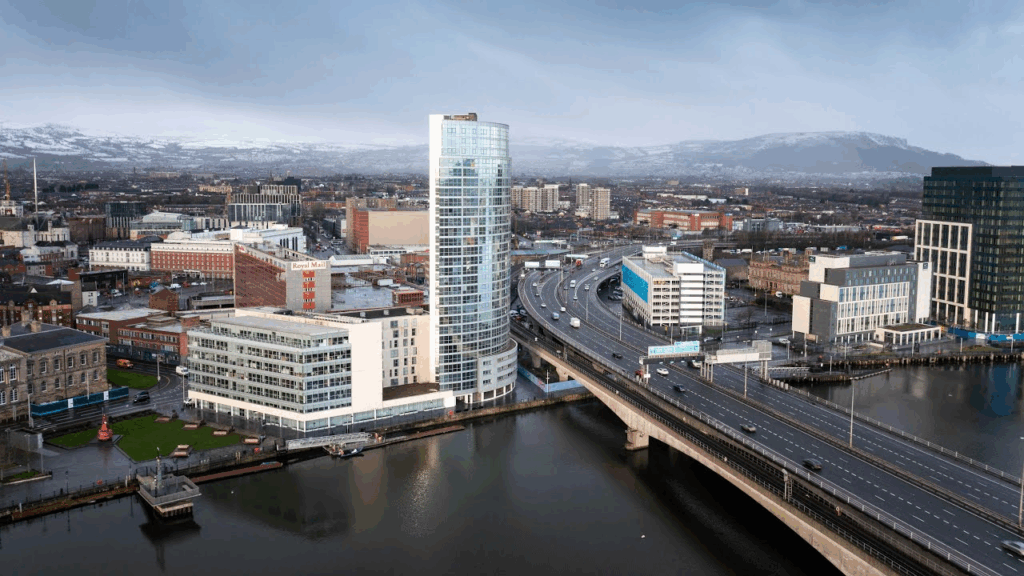
    On Donegall Quay where the Lagan meets the city, the Obel Building lifts a glassy curve into Belfast’s skyline. Completed in 2010–2011, it stands about 85 m tall with 28 storeys, making it the tallest building in Belfast (and on the island of Ireland). The scheme was designed by Broadway Malyan, with residential apartments stacked above ground-floor retail and a separate office element.

    The project launched in the mid-2000s boom, hit the brakes in the financial crisis, then crossed the finish line around 2011. Soon after opening, Allen & Overy took the available office space; the residential tower later went through administration in 2012 before being acquired in 2014 and refurbished in 2016. Today it anchors the revitalised waterfront, a modern counterpoint to the Lagan Weir and the bridges beside it.

    Quick facts:

    • Height / floors: ~85 m, 28 storeys.
    • Where: 62 Donegall Quay, right on the River Lagan.
    • Use: Mostly residential, with offices and ground-floor units.
    • Architect: Broadway Malyan.
    • Claim to fame: Tallest building in Belfast and Northern Ireland (and widely cited as tallest in Ireland).

  • Ashby Building

    Image

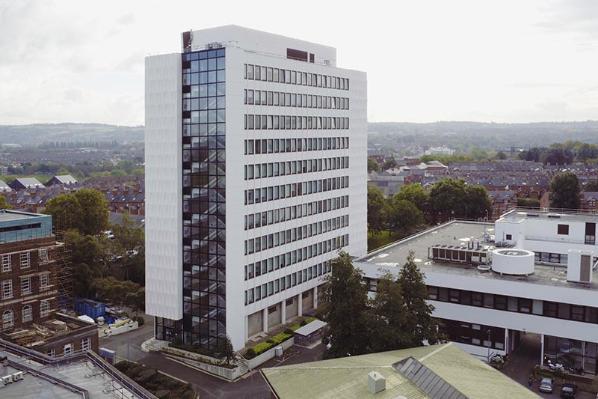
    On Stranmillis Road, a crisp white tower rose in the 1960s. Manchester firm Cruickshank & Seward drew it in 1960; by 1965 the reinforced-concrete frame wore an Antrim limestone skin, and in 1966 the doors finally opened.

    It took its name from Sir Eric Ashby — the reforming vice-chancellor who led Queen’s through a building boom and, fittingly, performed the opening ceremony.

    Since then the Ashby has been an engine-room of the university: eleven storeys of labs, lecture theatres and research groups, home to Mechanical & Aerospace Engineering and EEECS, with the Advanced Micro-Engineering Centre perched on the 10th floor.

    A major £26 million refurbishment between 2010–2013 polished (but didn’t tame) its modernist lines; in 2018 it was graded B+ as one of Northern Ireland’s best large in-situ concrete buildings — a true South Belfast landmark.

  • Getting Around (And Staying Mostly Dry)

    Walking: City centre is compact — bring comfy shoes and faith in traffic lights.

    Buses: They’re pink. You can’t miss them. Contactless works, manners recommended.

    Trains: Handy for coastal runs to Bangor or beyond. Sit on the sea side for views and existential thoughts.

    Taxis: Black cabs and apps both fine; drivers double as historians and weather forecasters.

    Bikes: Great until you discover cobbles. Then… character building.

  • Belfast

    Short version: Belfast is the capital of Northern Ireland, birthplace of the RMS Titanic, and home to people who can discuss the price of a sausage roll with the seriousness of a UN summit.

    Where it is: North-east corner of the island of Ireland, hugging the Belfast Lough like a cat that pretends it’s not needy.

    Population: ~350k in the city; ~700k in the metro area (give or take visitors who came for a weekend and accidentally moved in).

    Famous for: Shipbuilding, linen, murals, cracking music, and saying “wee” before absolutely everything. (Fancy a wee coffee?)

    Vibe check: Friendly, witty, a bit windy. The accent has settings from “BBC clear” to “needs subtitles,” both equally charming.

    Claim to fame: You can literally have mountains (Cave Hill), sea (Belfast Lough), and flat whites (every street) within 20 minutes of each other — traffic and rain gods permitting.

    Fun myth: Locals will tell you you’re “grand” even if your umbrella is inside-out and you’ve just stepped in a puddle that had its own climate system.