Tag: buildings

  • Belfast City Hall

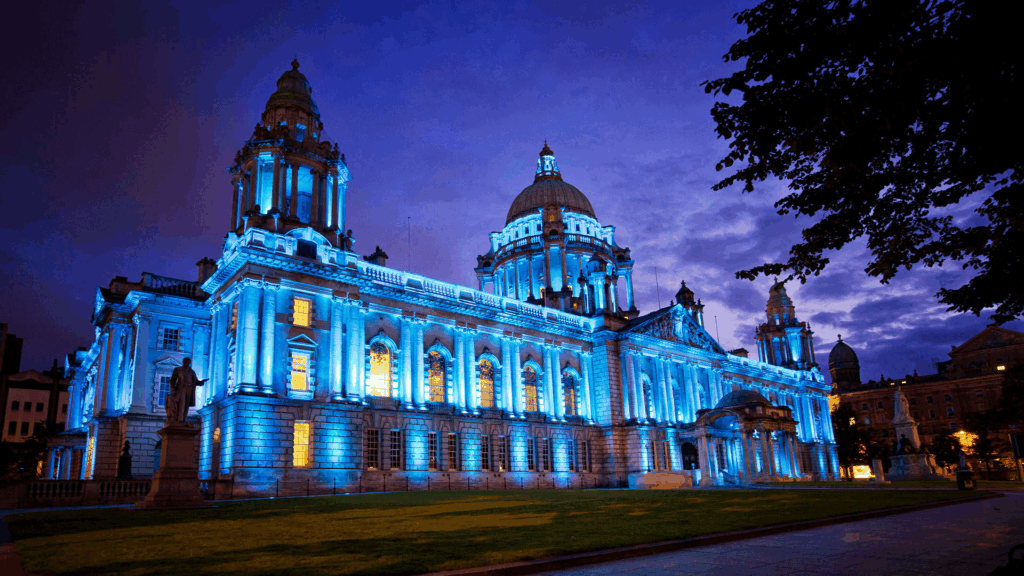
    Belfast City Hall

    On Donegall Square, Belfast City Hall sprawls like an Edwardian “wedding cake” of Portland stone and copper—grand, symmetrical, and impossible to miss. Designed by Sir Alfred Brumwell Thomas, construction began in 1898 and finished in 1906, crowning the city’s new status as a bustling industrial capital.

    City Hall replaced the old White Linen Hall and signalled civic confidence during Belfast’s boom years. It has witnessed everything from royal visits to wartime blackouts and post-conflict celebrations. A major restoration closed the building in 2007–2009, renewing services and interiors (about £10.5 m across phases), before reopening to the public with refreshed tours and galleries.

    Out on the lawns, memorials trace the city’s story: the Cenotaph to WWI dead and the Titanic Memorial Garden—opened on 15 April 2012—whose bronze plaques uniquely list all 1,512 victims of the disaster.

    Quick Facts:

    • Architect & style: Sir Alfred Brumwell Thomas, Baroque Revival/Edwardian grandeur.
    • Built: 1898–1906; cost: ~£360–369k (then).
    • Dome: ~173–174 ft (53 m), copper-clad; corner towers on all four sides.
    • Materials: Portland stone exterior; rich marbles inside.
    • Today: HQ of Belfast City Council; free public exhibition, tours, and café (“The Bobbin”).
  • Europa Hotel

    Image

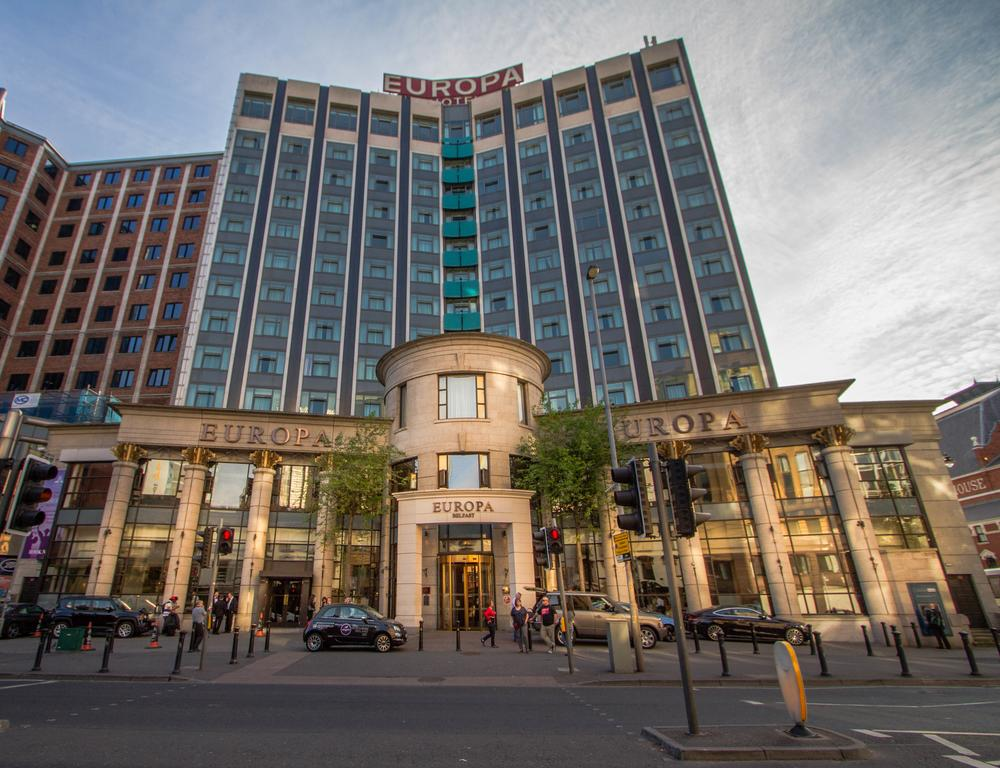
    On Great Victoria Street, the Europa Hotel rises like a silvered time capsule of Belfast’s grit and charm. Opened in 1971 on the site of the old Great Northern Railway terminus, the 12-storey, 51 m tower by Sydney Kaye, Eric Firkin & Partners became a front-row seat to history—and a city-centre beacon again today.

    Quick Facts:

    • Opened: July 1971; Architects: Sydney Kaye, Eric Firkin & Partners.
    • Height / floors: ~51 m, 12 storeys.
    • Rooms: 272 (after later extensions/refurbs).
    • Famous claim: Often described as the “most bombed hotel”—accounts vary, with sources citing ~28–33 attacks during the Troubles.

    From Troubles to turnaround

    Journalists made it their base through the worst years, but the hotel kept trading, then found a second life when Hastings Hotels bought it in 1993, invested ~£8 m and reopened in 1994. In November 1995, President Bill Clinton stayed here (110 rooms were booked for the entourage); the penthouse suite he used became the Clinton Suite. Recent years brought a five-year, £15 m refurbishment across all 272 rooms, bars, and meeting spaces—sealing the Europa’s status as a polished city landmark.

  • Titanic Museum

    Image

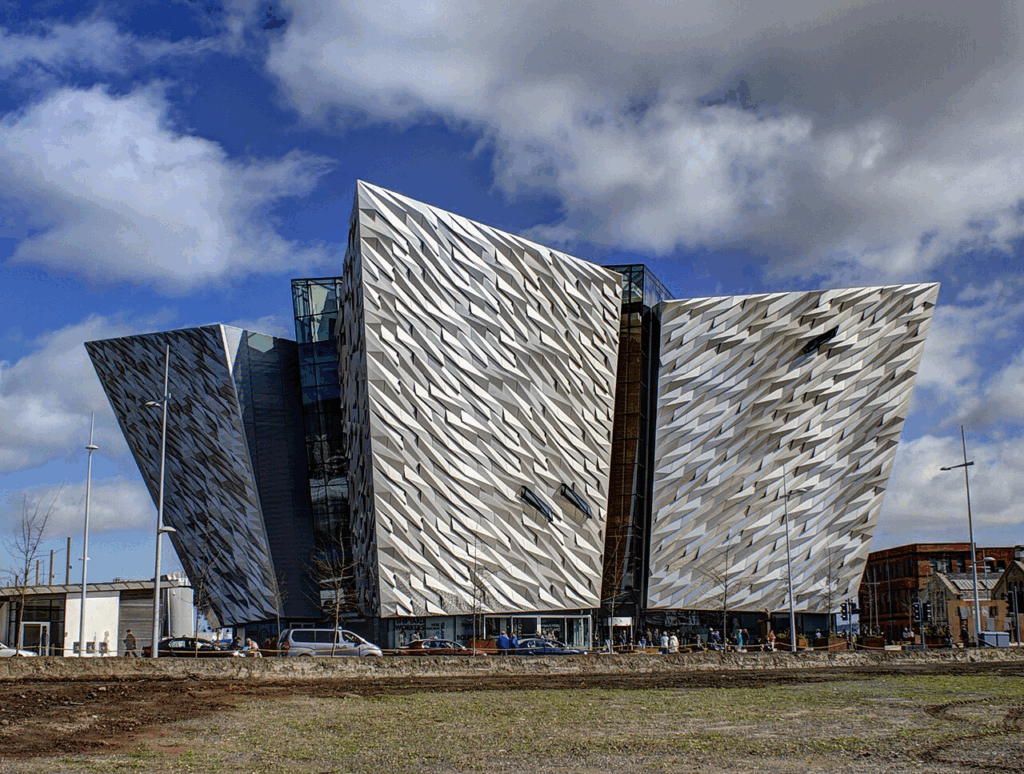
    On the old Harland and Wolff slipways, Titanic Belfast lifts four glittering “prows” into the sky—part ship, part iceberg, all theatre. Conceived by CivicArts / Eric R. Kuhne and Associates and delivered with Todd Architects, the 8-storey landmark opened for the centenary in March 2012 and has since become Belfast’s postcard icon.

    Quick facts:

    • Where and when: Titanic Quarter, on the very ground where RMS Titanic and Olympic were built; ground broke in 2009, doors opened 31 March 2012.
    • Architects: Concept by CivicArts / Eric R. Kuhne & Associates; lead consultants Todd Architects.
    • Height and scale: 38.5 m (126 ft) at the peak, roughly the height of Titanic’s hull; around 12,000–14,000 m² of floorspace.
    • Cladding: ~3,000 anodised aluminium “shards,” about 2,000 unique; ~6,200 m² of rainscreen.
    • Cost: ~£101 million.
    • Awards: World’s Leading Tourist Attraction (2016) at the World Travel Awards; also Europe’s Leading Visitor Attraction that year.

  • Obel Tower

    Image

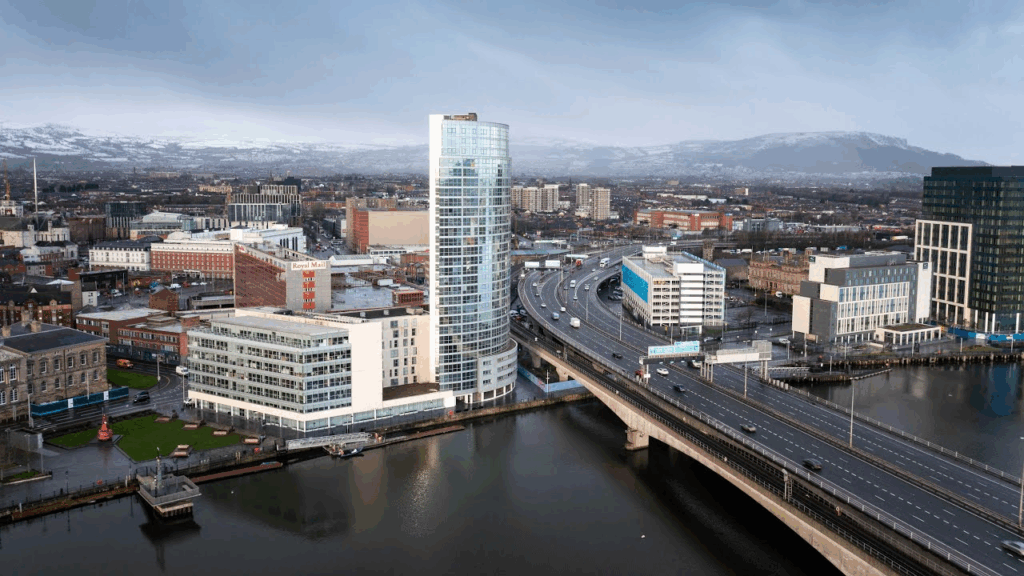
    On Donegall Quay where the Lagan meets the city, the Obel Building lifts a glassy curve into Belfast’s skyline. Completed in 2010–2011, it stands about 85 m tall with 28 storeys, making it the tallest building in Belfast (and on the island of Ireland). The scheme was designed by Broadway Malyan, with residential apartments stacked above ground-floor retail and a separate office element.

    The project launched in the mid-2000s boom, hit the brakes in the financial crisis, then crossed the finish line around 2011. Soon after opening, Allen & Overy took the available office space; the residential tower later went through administration in 2012 before being acquired in 2014 and refurbished in 2016. Today it anchors the revitalised waterfront, a modern counterpoint to the Lagan Weir and the bridges beside it.

    Quick facts:

    • Height / floors: ~85 m, 28 storeys.
    • Where: 62 Donegall Quay, right on the River Lagan.
    • Use: Mostly residential, with offices and ground-floor units.
    • Architect: Broadway Malyan.
    • Claim to fame: Tallest building in Belfast and Northern Ireland (and widely cited as tallest in Ireland).

  • Ashby Building

    Image

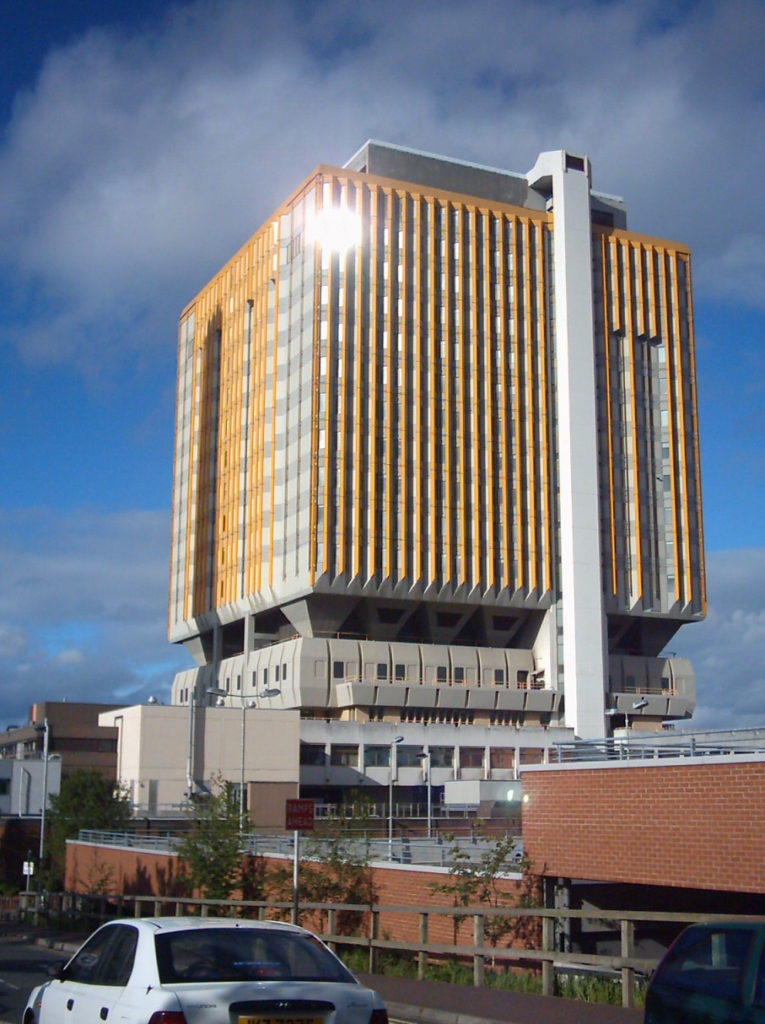
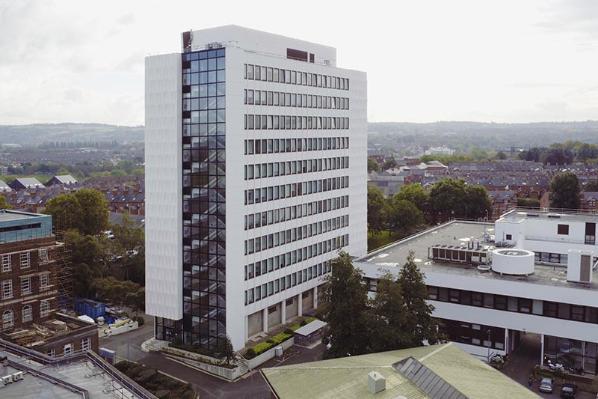
    On Stranmillis Road, a crisp white tower rose in the 1960s. Manchester firm Cruickshank & Seward drew it in 1960; by 1965 the reinforced-concrete frame wore an Antrim limestone skin, and in 1966 the doors finally opened.

    It took its name from Sir Eric Ashby — the reforming vice-chancellor who led Queen’s through a building boom and, fittingly, performed the opening ceremony.

    Since then the Ashby has been an engine-room of the university: eleven storeys of labs, lecture theatres and research groups, home to Mechanical & Aerospace Engineering and EEECS, with the Advanced Micro-Engineering Centre perched on the 10th floor.

    A major £26 million refurbishment between 2010–2013 polished (but didn’t tame) its modernist lines; in 2018 it was graded B+ as one of Northern Ireland’s best large in-situ concrete buildings — a true South Belfast landmark.